枯山水 karesansui
ka-re-san-sui
A dry garden of rock and raked gravel standing in for mountains and water.

What it is
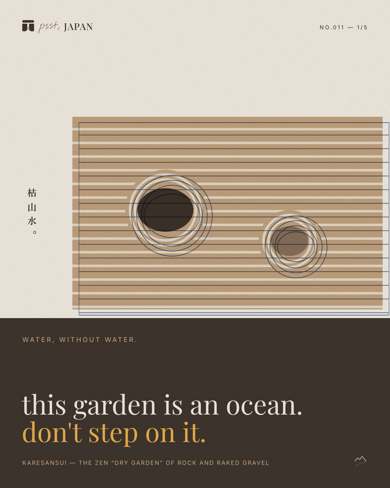
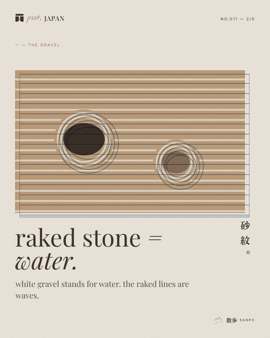
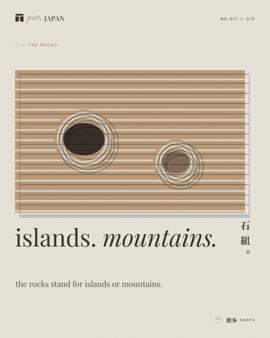
Karesansui means "dry landscape": a garden that shows mountains, rivers and seas without a single drop of water. Stones become mountains and islands. White gravel or sand becomes water, raked into ripples, waves or a flowing stream. Plants are kept to a minimum, sometimes just moss.
Some gardens even include a dry waterfall (karetaki), an arrangement of rocks that suggests falling water. Others tell a story across a sequence of spaces, with a gravel stream that widens into a river and finally an ocean.
The style expresses nature in abstract form. It's less a picture of a specific place than an invitation to fill in the rest yourself. These gardens are meant to be viewed from a seated position, usually from the veranda of a temple building, not walked through.
Why it matters
The term goes back to the 11th-century garden manual Sakuteiki, but karesansui as most people picture it took shape in the Muromachi period and continued through the Edo period. Its look owes a lot to Chinese ink landscape painting, and its rocks often evoke legendary mountains such as Penglai (Hōrai in Japanese), the island of the immortals.
That mix of landscape painting and spiritual imagery made the dry garden a natural fit for Zen temples, where it became the standard garden of the abbot's quarters (hōjō). In the 20th century, karesansui found a second life, at home and abroad, partly because its stripped-down forms look so close to modern abstract art.
Where to see it
- Ryōan-ji, Kyoto: the best-known example. Fifteen rocks in five groups on white gravel, south of the hōjō; the temple dates to 1450, though nobody knows exactly when the garden was made. From whatever angle you view it, you can never see all fifteen stones at once. Part of the "Historic Monuments of Ancient Kyoto" World Heritage Site.
- Daisen-in (a sub-temple of Daitoku-ji), Kyoto: a tiny, dense garden from the early 16th century, where rock and white sand show water springing up deep in the mountains and running down as a river, until it empties into a flat expanse of white gravel.
- Many other Zen temple sub-temples in Kyoto; check each one's photo rules at the gate
Manners
- Never step onto the gravel or touch the rocks. The raked patterns are redone by hand
- Sit on the veranda and give it time. These gardens are built to be looked at slowly
- Keep your voice down; others are there for the quiet
- Respect photo bans where posted, and don't use flash or tripods in crowded halls
psst,
Go at opening time. Ryōan-ji first thing in the morning and Ryōan-ji at noon feel like two different gardens.