関守石 sekimori-ishi
se-ki-mo-ri-i-shi
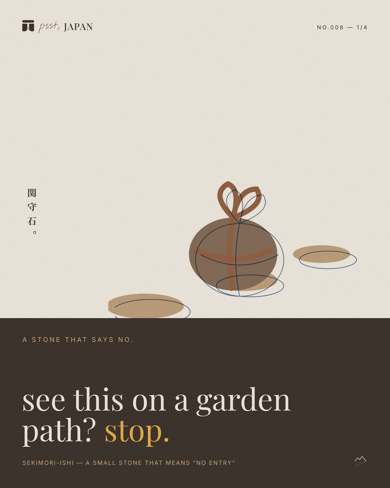
A small rope-tied stone on a garden path that means "not this way."
What it is
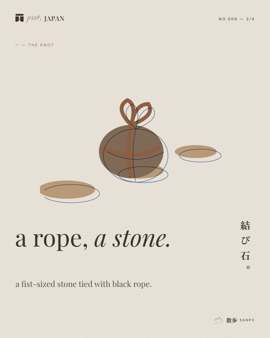
You're walking a stepping-stone path in a Japanese garden and there it is: a stone about the size of a fist, sitting on top of one of the stepping stones and tied crosswise with dark rope, like a tiny wrapped parcel. That's a sekimori-ishi, literally a "barrier-keeper stone." It's also called tome-ishi, a "stopping stone."
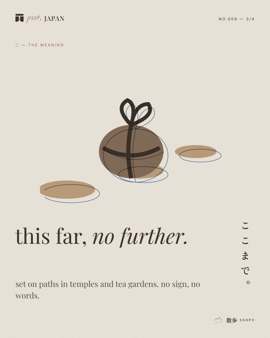
Its message is simple: don't go this way. The path continues, but you're not invited to follow it. The rope, usually dyed palm-hemp or bracken fiber, is what tells you the stone was placed on purpose and isn't just lying there.
No sign, no rope barrier, no guard. Just one stone that everyone understands.
Why it matters
Sekimori-ishi belong to the world of the roji, the garden path that leads to a tea house. A host would use them to guide guests along the right route on the day of a gathering, quietly closing off other paths without spoiling the garden with signs.
That's what makes them such a neat piece of Japan: a rule enforced entirely by shared understanding. The stone doesn't physically stop anyone. It works because the person walking the path is trusted to read it and to respect it. If you know the code, the garden talks to you.
Where to see it
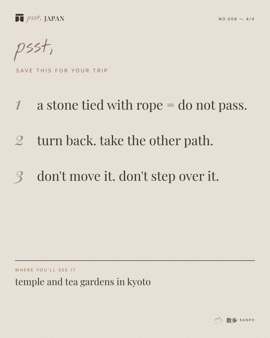
- Tea gardens (roji) at Kyoto temples and sub-temples that have tea houses
- Japanese gardens at temples, villas and historic houses, often where a side path branches off a main one
- Some traditional ryokan and restaurants with gardens
Manners
- Treat it as a closed door. Turn back and take the other path
- Don't move it, step over it or pick it up for a photo
- Photograph it where it sits; it makes a great detail shot
- If you're unsure which path is open, ask staff rather than guessing
psst,
Once you've spotted one, you'll start seeing them everywhere: at tea houses, in temple gardens, even in the occasional restaurant courtyard. Most visitors walk right past them.