看板 Japanese signs, explained
kanban — shop and street signs
Twenty signs on restaurant doors and street corners that decide whether you eat, enter or wait.
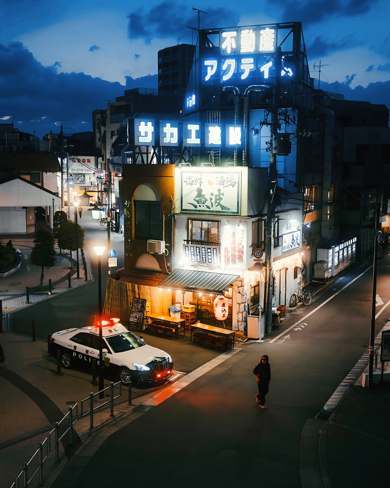
You don’t need to read Japanese to get around. You need about twenty words, and most of them hang on a door. Here they are, grouped by the question they answer.
At the door: can I go in?
The shop is open now. Come in.
Not closed for good. Often shown before opening and in the break between lunch and dinner. It’s usually the back of the 営業中 board.
One group has the whole place today. It isn’t about you, and asking won’t change it. Try another night.
The day of the week the shop always closes. 不定休 (fu-teikyū) means the closing days change.
A one-off closure: illness, a holiday, a family event. Usually back soon.
No seats right now. Some places let you wait outside; some don’t take a queue at all.
Small shops make a set amount each day. When it’s gone, they close early.
Ordering: how does this place work?
Buy a ticket from the machine by the door first, then hand it to staff. Common at ramen, soba and set-meal shops. Older machines may take cash only.
The kitchen stops taking orders here, before closing time. If you arrive close to it, order everything at once.
Take one and come back at the time or number shown, instead of standing in line. On some local buses it’s the ticket that decides your fare.
No cards here. Check before you sit down, not after you eat.
No walk-ins. Book ahead, or ask your hotel to call.
Rules: what not to do here
Shoes off at the step. Temples, ryokan, some restaurants and fitting rooms. Use the slippers if they’re offered.
Phones count, and usually video too. Common in temple halls, museums and some shops.
Many streets are no-smoking too. Smoke only where you see 喫煙所.
Often 関係者以外立入禁止: staff only. Gardens, back lanes and private land use it.
On the street
On a red, upside-down triangle. Many newer signs also say STOP in English underneath.
On doors. Easy to mix up — 引 has the bow-shaped 弓 on the left.
Stations number their exits (出口 A3). Pick the exit before you go up the stairs.
Toilets and baths. At onsen, curtain colours can swap — trust the kanji, not the colour.
Three habits that help
- Read the door, not the window. The hanging board or the paper taped to the glass is today’s news. Posters in the window can be years old.
- No noren, not open. If the curtain isn’t hanging in the doorway, the shop usually isn’t open yet — even if the lights are on.
- Let your camera read it. A translation app on your phone handles most signs. Point it at the sign, not at the staff or other diners.
psst, 準備中 is the one that catches people out. It means “come back later”, not “closed forever”. The hours are usually written right next to it.